Did you know that RCA was part of the Apollo Project?
NASA awarded contracts to the RCA Astro Electronics Division to develop:
-
The special black-and-white, slow-scan RCA Vidicon television cameras for the command modules of the Apollo 7 and 8 missions.
-
The RCA color camera (J-series) with a field-sequential color system, part of the Ground-Commanded Television Assembly (GCTA), for lunar surface operations on Apollo missions 15, 16, and 17.
1964: The RCA Vidicon Cameras and the Ranger 7 Lunar Surface Probe
In 1964, NASA successfully launched Ranger 7. RCA was an important subcontractor on the Ranger lunar probes, developing the cameras that would transmit high-resolution photographs of the lunar surface.
On July 31, 1964, Ranger 7 took the first close-range pictures of the Moon. Six RCA Vidicon television cameras took these pictures: two full-scan cameras and four partial-scan cameras.
The Ranger program was a series of nine unmanned United States space missions between 1961 and 1965. Its objective was to obtain the first close-up images of the surface of the Moon: large-scale topographic information necessary to prepare for the Surveyor and Apollo projects. The Ranger spacecraft would take high-resolution images of the lunar surface and transmit those images to Earth until impact destroyed the spacecraft.
Ranger 7 was the first U.S. space probe to successfully transmit close-up images of the lunar surface back to Earth and the first successful flight of the Ranger program. Ranger 7 reached the Moon on July 31, 1964.
1968–1972: RCA High-Resolution Cameras Selected for the Apollo Lunar Landing Program
NASA selected and successfully used RCA cameras for several missions of the United States’ Apollo space program:
1. RCA Vidicon Black-and-White SSTV (Slow-Scan Television System) Cameras for Flights:
-
APOLLO 7 (October 1968)
-
APOLLO 8 (December 1968)
The Camera's Historical Development
NASA decided on initial specifications for TV on the Apollo command module (CM) in 1962.
NASA awarded RCA the contract to manufacture such a camera. At the time, NASA understood that a slow-scan television system (SSTV) would offer lower motion fidelity than standard commercial television systems but deemed it sufficient, considering that astronauts would not move quickly in orbit or even on the lunar surface.
NASA selected an RCA scan converter to convert the black-and-white SSTV signals from the Apollo 7, 8, 9, and 11 missions.
Operational history: Apollo 7 and Apollo 8 used an RCA slow-scan, black-and-white camera.
On Apollo 7, astronauts could fit the RCA camera with either a wide-angle, 160-degree lens or a telephoto lens with a 9-degree angle of view. The RCA camera did not have a viewfinder or a monitor, so astronauts needed help from Mission Control when aiming the camera in telephoto mode.
Specifications: The RCA camera used interchangeable lenses, including a wide-angle lens with a 160-degree field of view and a 100 mm telephoto lens.

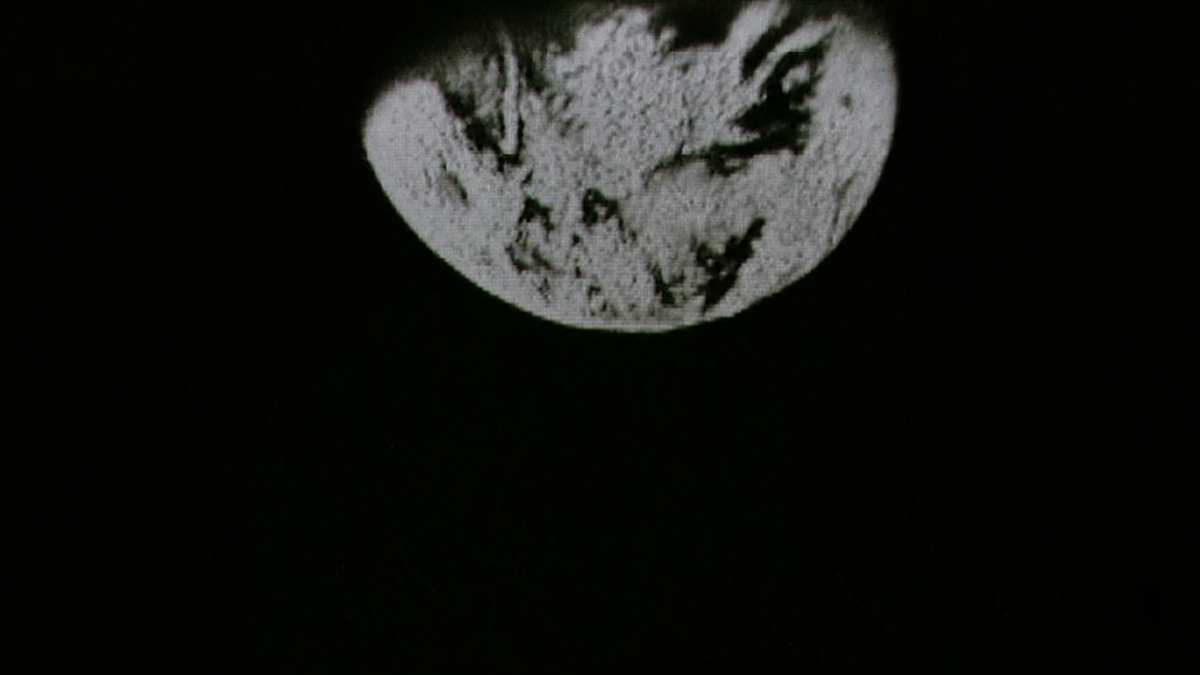
(NASA photo: Earth seen during the Apollo 8 live TV transmission on December 23, 1968, using the 100 mm telephoto lens on the RCA command module TV camera.)
2. New RCA J-Series Model with a Field-Sequential Color System, Part of the GCTA (Ground-Commanded Television Assembly), for Flights:
-
APOLLO 15 (July–August 1971)
-
APOLLO 16 (April 1972)
-
APOLLO 17 (December 1972)
After Apollo 12, NASA awarded a new contract to the RCA Astro Electronics facility in East Windsor, New Jersey, for the lunar surface operations of Apollo missions 15, 16, and 17.
The RCA system used a new, more sensitive and durable TV camera tube. The public could see the improved image quality through the RCA camera's better tonal detail in the midrange and the lack of the blooming apparent in previous missions.
The system consisted of the RCA color television camera (CTV) and the television control unit (TCU). These connected to the lunar communications relay unit (LCRU) when mounted on the Lunar Roving Vehicle (LRV). It used the field-sequential color system and ground-station signal processing and color decoding techniques to produce a broadcast NTSC color video signal.
On Apollo 15, the RCA camera produced live images from the Lunar Module's Modularized Equipment Stowage Assembly (MESA), just as on previous missions. Astronauts repositioned this RCA camera from the MESA onto a tripod, where it photographed them deploying the Lunar Roving Vehicle (LRV). Once they fully deployed the LRV, the astronauts mounted the RCA camera there, and operators on the ground sent commands to tilt, pan, and zoom in and out.
Apollo 15 was thus the last mission to have live video of the mission's first steps via the MESA, as crews on the following flights stowed the camera with the LRV.
(Source: Wikipedia, “Apollo TV camera”)
1969: A Look at the Apollo Space Suit

As all eyes turned to the Moon and the innovations the lunar landing represented, the cover of RCA Electronic Age magazine (Spring 1969 issue) described the Apollo suit for the “Man on the Moon.” The editors said:
“The Apollo space suit for the 'Man on the Moon' is man's electronic link to his earthly environment while in space or on the moon.
"Within his suit and its life-support backpack are systems to provide oxygen for his breathing and pressurization and water for body cooling.
"There are electronic equipment to relay his medical data to doctors back on earth and VHF radios to keep him in constant communication with fellow astronauts as well as with mission control.”
RCA Celebrates the 50th Anniversary of the Apollo 11 Lunar Landing.
America’s quest to put a man on the Moon in 1969 demonstrated what people can accomplish when everyone works together with a common, lofty goal.





Share: